Cold Storage Racking Systems: Efficient Solutions For Low-temperature Storage
Hi, are you considering cold storage warehousing? Or maybe you are already operating a cold storage facility but are facing some challenges? Cold storage warehousing is indeed very important, ensuring the freshness and quality of food, pharmaceuticals, and many other critical materials. But it also presents unique challenges, such as extremely low temperatures, difficult-to-control humidity, and high energy costs. These environmental factors impact every component in the warehouse, especially the racking system.
In such demanding environments, an efficient racking system that is suited to the characteristics of cold storage is no longer an option, but a must. It is directly related to storage density, operational efficiency, energy consumption and even personnel safety. Choosing the wrong shelving system can lead to damage, inefficiency and even safety incidents.
This article will take an in-depth look at the specific shelving requirements of the cold storage environment, break down a few of the main types of cold storage shelving, compare high-density storage options, see how automation fits in, and discuss key points of design, safety and maintenance. We'll also look at some success stories and look at future trends. Our goal is to help you understand how to make the smartest shelving choices in cold storage.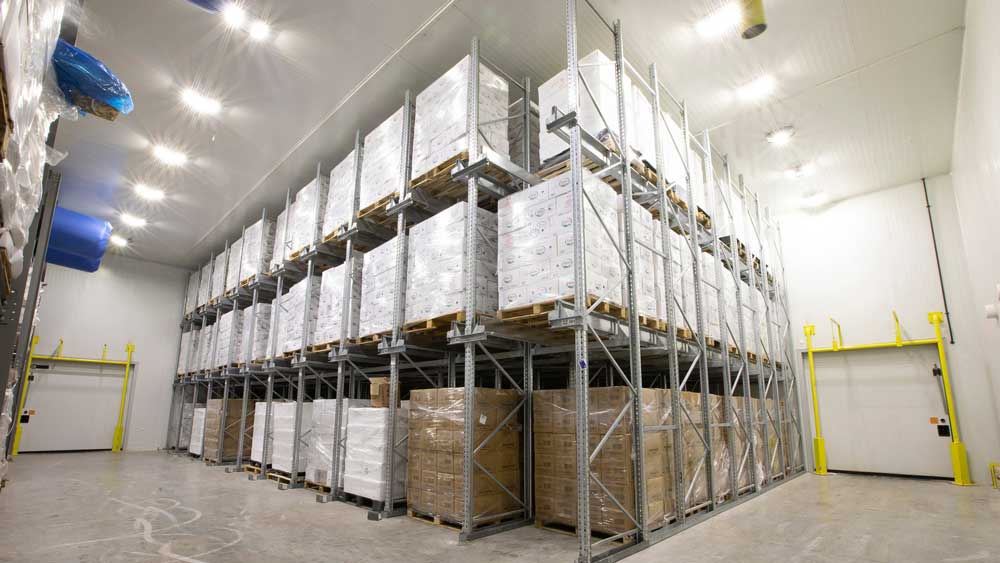
The special requirements of cold storage environment on the shelving system
Did you know? The extreme environment of cold storage is a huge test for ordinary warehouse shelving. Here, shelving is more than just a frame for storing goods; it must be able to withstand the physical changes brought about by low temperatures, while coping with humidity and frost.
Low temperatures can affect the performance of shelving materials. For example, certain metals become more brittle at very low temperatures and break easily. Dramatic changes in temperature can also lead to thermal expansion and contraction of materials, which can trigger structural deformation over time, affecting the load-bearing capacity and stability of the shelves. Humidity is even more of a troublemaker. High humidity environment, water vapor will condense or even ice, attached to the shelf surface. This may not only lead to shelf corrosion, icing will also increase the self-weight of the shelf, change the stability of the goods, and even make the channel become slippery and unsafe. Finally, energy efficiency is a top priority in cold storage. The layout and type of shelving system will directly affect the circulation and distribution of cold air, thus affecting the energy consumption of refrigeration equipment. An ill-designed shelving system may result in blocked cold air flow, creating temperature dead zones, or allowing cold air to be lost for nothing, increasing operating costs.
Therefore, the selection of shelving for cold storage should never be taken lightly and requires careful consideration of the special requirements brought about by these environments.
Major Cold Storage Shelving System Types Explained
There are a variety of shelving systems on the market, but not all are suitable for cold storage. Different shelving types have different working principles and applicable scenarios. Let's take a look at a few of the major ones and how they perform in cold storage.
Selective Pallet Racking
This type of racking is probably the most familiar to you. It consists of columns and beams that allow direct access to one pallet per bay.
Its most important feature is high flexibility, you can directly access any pallet, very suitable for a variety of goods, in and out of the warehouse frequency of cold storage. You can easily deposit or remove any goods at any time. However, its storage density is relatively low. The large number of aisles takes up a lot of space, which can be a significant limitation in a cold storage facility where land is scarce and energy consumption is expensive. If you have limited cold storage space or need to store a large number of similar goods, selective shelving may not be the most economical option.
Drive-In / Drive-Thru Racking
Looking for a significant increase in storage density? Drive-In Racking is a common solution. In this system, forklifts “drive” directly into the aisles inside the racking to access the goods.
It usually works on the principle of “last in, first out” (LIFO). This means that the last goods to be deposited in the aisle are the first to be removed. Drive-in racking, on the other hand, can be accessed at both ends of the aisle and supports FIFO, but is not as widely used as drive-in racking. The biggest advantage of drive-in racking is high density storage, which greatly reduces aisle space, leaving the majority of the area for storage. In cold storage, this means you can store more goods in the same amount of space, or the same amount of goods in a smaller cooler, thus reducing building and operating costs. However, forklift trucks require higher operator skills and less access flexibility as they need to operate in narrow aisles. Special attention needs to be paid to aisle width, headroom and crash protection.
Push-Back Racking
Push-Back Racking is another solution that provides high density storage. It combines some of the density benefits of drive-in with better access flexibility.
It also works on the principle of “last in, first out” (LIFO), but does not require a forklift to drive inside the rack. Goods are placed on dollies with wheels or rollers. When a new pallet is deposited, it “pushes” the pallet in front of it to move back one position. When removed, the pallet behind slides under gravity or mechanical force to the pick-up end. Push-back racking provides a higher storage density than selective racking, while each aisle can store different types of goods, unlike drive-in, where one aisle is best for only one type of goods, so it strikes a good balance between density and selectivity. In cold storage, it reduces the distance traveled by forklifts in low-temperature areas and improves operational efficiency.
Pallet Flow Racking
Gravity racking may be ideal if your cold storage facility requires strict FIFO (First In First Out) compliance, such as batch management for food or pharmaceuticals.
It works by utilizing the slope of a roller or slide. Goods are deposited from the high end of the shelf and automatically slide under gravity to the pick-up opening at the low end. With each pallet removed, the pallets behind it are automatically replenished. This system ensures first-in-first-out and is ideal for situations where tight batch control is required, goods turnover is fast and stock depths are large. In cold storage, it improves access efficiency, reduces forklift dwell time in the aisle and helps maintain temperature stability. However, its construction requires a high degree of precision and has certain requirements for pallet quality and cargo packaging to ensure smooth sliding.
Mobile Pallet Racking
Want to maximize your cold storage space? Check out Mobile Pallet Racking. It's probably one of the most space-efficient of all pallet racking systems.
This system features a racking body mounted on a removable base that moves along a track laid on the floor. By moving the shelves, you only need to reserve one or very few working aisles. When you need to access which row of goods, you move the shelves to open the corresponding aisle. This greatly reduces the aisle space, leaving more area for storing goods. In cold storage, this means that the total volume to be cooled can be significantly reduced, resulting in considerable energy savings. However, mobile shelving systems have a higher initial investment and are slower to operate than fixed shelving, making them suitable for cold stores where space utilization is critical but access frequency is relatively constant.
Pallet Shuttle System
Want to achieve high density storage in your cold room while increasing automation? The Pallet Shuttle System offers a semi-automated solution.
This system combines a gravity or push-back aisle storage concept with a motorized shuttle. A forklift places the goods on the shuttle at the entrance of the aisle and the shuttle automatically transports the goods to a designated location within the aisle. When picking up the goods, the shuttle car transports the goods out of the aisle to the aisle entrance, where they are removed by the forklift. It can support FIFO or LIFO, depending on whether the aisle is a single- or double-ended design.
The shuttle car system significantly improves access efficiency and storage density, reduces the need for forklift access to cold-temperature aisles, and reduces personnel working hours in extreme environments. It is particularly suitable for cold storage with large batches and relatively single species, and can even operate stably in ultra-low temperatures as low as minus tens of degrees Celsius.
Benefits and Options for High-Density Storage Solutions in Cold Storage
In cold storage, every cubic meter of space is worth a lot of money because you need to continuously invest in energy to maintain low temperatures. That's why high-density storage solutions are especially important in cold storage.
With high-density storage, you can store the same amount of goods in less space, which means a smaller building volume, less insulation, and most importantly - less refrigeration energy. This translates directly into significant reductions in operating costs. The drive-in, push-back, mobile and shuttle systems we mentioned earlier are all typical high-density options.
So, faced with these options, how do you decide? It depends on your specific needs and budget.
- Drive-In/Drive-Out: If you have a small variety of goods and don't mind LIFO (with a small amount of FIFO support) and are cost sensitive, drive-in is the basic high-density option.
- Pushback: If you need LIFO, but want better selectivity than drive-in (each aisle can hold different goods), and more convenient operation, pushback is a good balance.
- Mobile: If space utilization is an absolute priority, you are willing to invest in higher upfront costs, and access frequency is relatively fixed, mobile can provide the highest density.
- Shuttle: If you need high density, are looking for higher levels of efficiency and automation, reduced staffing in low-temperature areas, and your budget allows it, shuttle systems are a modern and efficient solution, especially for large-scale, batch storage.
The best solution is always customized. You need to carefully evaluate your inventory turnover rate, the number of goods types, the access mode required (FIFO or LIFO), the amount of space available, and your investment budget to make a decision.
Automation in Cold Storage Racking Systems
Want to make your cold storage smarter, more efficient, and friendlier to your employees? Automation could be the answer. In extreme environments like cold storage, automation offers particular advantages.
First, automated systems can significantly reduce the amount of time and frequency of personnel exposure to cold temperatures, which is critical to employee health and safety. Second, automated equipment (e.g., stackers, shuttles) operate more accurately and consistently, which can improve access efficiency and reduce operational errors and cargo damage. They also enable finer inventory management and goods tracking. Automated storage and retrieval systems (AS/RS) are an important part of cold storage automation. They can be Miniload AS/RS for handling individual cartons or boxes, or Unit-load AS/RS for handling entire pallets.These systems can be combined with a variety of racking structures to automate the entire process from inbound to outbound.
The previously mentioned shuttle racking system, which itself belongs to the semi-automation category, is an important step towards full automation. By integrating automation systems, cold storage can achieve higher throughput, lower operating costs and more reliable operations.
Design, Safety and Maintenance of Cold Storage Shelving Systems
Designing a shelving system for cold storage is more than just picking a type. You need to consider a series of specialized factors to ensure the long-term stable operation and safety of the system.
The design must strictly adhere to the relevant design standards and specifications. These specifications take into account material properties in low-temperature environments, the load-bearing capacity of the shelves, seismic performance, and coordination with other systems such as refrigeration and fire protection. Material selection is critical, requiring the use of steel that can maintain good performance at low temperatures and specialized surface treatments, such as galvanizing or special coatings, to resist moisture and corrosion. The safety features of the shelves also need special attention, such as the installation of anti-collision columns or guardrails to protect the shelf columns from forklift impact; reasonable planning of the width and layout of the channel to ensure smooth and safe operation.
Finally, daily inspection and maintenance is the key to ensure the safe operation of cold storage racking systems. Under a low temperature environment, icing may hide structural problems, and small deformation may be expanded due to low temperature stress. Regularly check whether the columns, beams and connectors of the shelves are deformed, damaged or corroded, clean up the ice and frost, tighten the bolts in time, and carry out the necessary repairs and maintenance, which is an indispensable link to ensure the load-bearing capacity and service life of the shelves.
Successful Case Studies of Cold Storage Racking Systems
Theoretical knowledge is important, but looking at real-world examples can help you understand even more. Numerous successful cold storage racking solutions can be found across various industries.
For example, in the food industry, a large frozen food distribution center may have used a shuttle rack system. With this high-density, semi-automated solution, they have solved the challenge of how to store a large number of SKUs in a limited amount of frozen space, while improving order picking efficiency and reducing the discomfort of forklift drivers working long hours in -18 degree Celsius environments.
Vaccine storage facilities within the pharmaceutical sector may utilize mobile shelving equipped with temperature surveillance. Not only does this maximize storage density to cope with the stringent storage volume requirements for vaccines, but integrated temperature sensors monitor the temperature near each bay in real time, ensuring that vaccines are always within the required temperature range to meet strict compliance requirements.
These examples show how the selection and customization of shelving systems based on specific storage needs, environmental challenges and operational goals have resulted in tangible benefits, such as doubling storage capacity, improving picking efficiency by 30%, reducing energy consumption by 15%, and more (note: the data here is an example; actual cases need to be backed up by specific data).
Future Trends: Intelligence and Sustainability
Looking to the future, cold storage shelving systems are moving in a smarter and more sustainable direction. Innovations in technology are fundamentally transforming the operations of cold storage facilities.
Intelligence is the obvious trend. Cold storage racking systems will be more closely integrated with Warehouse Management Systems (WMS) and Internet of Things (IoT) technologies. By installing sensors on the shelves, we can monitor in real time the status of the goods, the location of the goods, and even link with the environmental monitoring system to monitor the local temperature and humidity. This intelligent management can lead to more accurate inventory tracking, more efficient route planning, and even predictive maintenance through the collection of operational data to intervene before potential problems with the shelves occur and prevent breakdowns.
Sustainability is also increasingly emphasized. Cold storage shelving of the future is likely to be made from more environmentally friendly materials, reducing the carbon footprint of the production process. The design will also focus more on energy saving, for example by optimizing the structure to reduce the use of steel, or by designing shelf forms that are more conducive to cold air circulation. Combining renewable energy sources, such as solar power, with the power requirements of mobile shelving or automated systems is also a potential development. These trends will help cold storage operators improve efficiency while reducing environmental impact and further cutting long-term operating costs.
Conclusion
Well, we have explored all aspects of cold storage shelving systems together. I trust this explanation has provided you with a clearer understanding of the subject.
Selecting and designing a great cold storage shelving system is key to ensuring the efficient, safe, and economical operation of your cold storage facility. This requires you to carefully consider the unique environmental challenges of cold storage, define your storage needs (e.g., density, access patterns, types of goods, and turnover rates), and evaluate the advantages and disadvantages of different shelving types. Remember, there is no one-size-fits-all best solution, only the one that works best for you.
We highly advise consulting with a professional. Work with an experienced shelving supplier or logistics system integrator who can provide you with a customized solution based on detailed designs and calculations for your specific situation. This will ensure that the racking system you choose not only meets your current storage needs, but also adapts to future developments and operates stably and safely over the long term in the demanding environment of cold storage.
The future of cold storage warehousing will be smarter and more sustainable. By investing in the right racking system, you are laying a solid foundation for your cold storage business to meet the challenges and opportunities of the future.