The Ultimate Guide to Push Back Racking: How to Increase Storage Density by 80%
I've always believed that when choosing a racking system for your warehouse, there's no need to blindly chase after smart features or special functionalities. That's why every type of shelving I introduce to our readers is intended to offer a quick understanding, enabling them to make a choice that aligns with their actual storage needs.
The same principle applies to the push back racking system that I will introduce to you next. If you need the flexibility of selective racking but also require the density of drive-in racking, then Push Back Racking might be the solution you are looking for.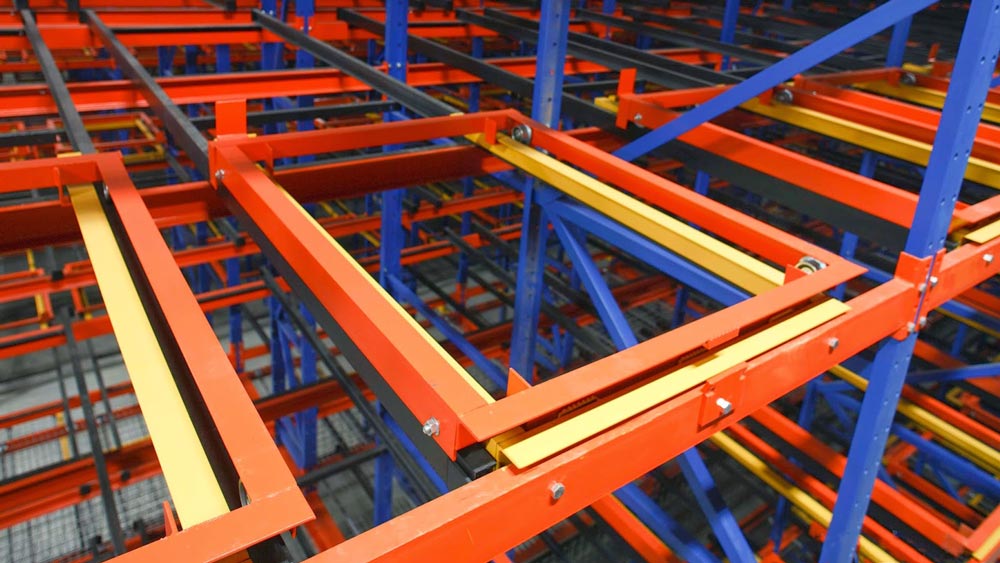
What is push back racking?
Push Back Racking is essentially a LIFO (Last-In, First-Out) high-density storage system. You can imagine it as a multi-level, inclined rail/cart system.
Its operating principle is simply divided into two steps: loading and retrieval:
- Loading: When your forklift places a new pallet onto the front of the rail, you don't need to drive it deep into the system. With a gentle push, this new pallet slides along the inclined rail, pushing the existing pallets further back one position. Think of it like reaching for a carton of cooking oil on a supermarket shelf and pushing the items behind it to the front.
- Retrieval: When you need to retrieve a load, you always take the last pallet you put in from the front face. Once that pallet is removed, the subsequent pallets automatically slide forward to the front pick-face position, due to the rail's incline, awaiting the next retrieval.
Is push back racking right for me?
For those who are new to push back racking, you might be wondering: Is this system suitable for my warehouse? I've anticipated this question, so I've put together a quick questionnaire. By answering these multiple-choice questions, you can quickly determine if push back racking is the right fit for you.
Question 1: What is your inventory storage and retrieval principle?
- A. My goods do not require strict adherence to "First-In, First-Out" (FIFO). They may have an expiration date, but batch management is not strictly enforced, or the items—such as paper, hardware, or packaging materials—are not significantly affected by storage time.
- B. My goods must strictly follow "First-In, First-Out" (FIFO), such as food, pharmaceuticals, or chemical products with strict batch requirements.
Initial Judgment:
- If you chose A, Push Back Racking (which is LIFO) meets your requirements. Please continue to the next question.
- If you chose B, Push Back Racking is generally not suitable for you. You should primarily consider Drive-In Racking or Pallet Flow Racking.
Question 2: What is the inventory depth for each of your Stock Keeping Units (SKU)?
- A. For the same SKU, I typically have inventory ranging from 2 to 5+ pallets. I want to store them all together in a concentrated area.
- B. I have a very large number of SKUs, but each SKU usually only has 1, or at most 2, pallets of inventory.
Initial Judgment:
- If you chose A, Push Back Racking is an excellent fit. Its design is specifically for the efficient storage of multiple pallets of the same SKU.
- If you chose B, then Traditional Selective Racking might be more economical and flexible.
Question 3: Is your warehouse under significant space and budget pressure?
- A. My warehouse land/rental costs are high, space is extremely valuable, and I urgently need to increase storage density, willing to invest for this purpose.
- B. My warehouse space is still relatively sufficient, and my current budget is limited, so I'm looking for the most economical solution.
Initial Judgment:
- If you chose A, Push Back Racking is an excellent space-saving solution. It can significantly reduce aisle space, effectively "creating" more space for you.
- If you chose B, Selective Racking remains the option with the lowest initial investment.
Question 4: What are your product and forklift operation conditions?
- A. My product weight is moderate (typically less than 1500kg/pallet), and my forklift drivers are skilled.
- B. My goods are very heavy (over 2 tons), or operational safety is the top priority in my warehouse, and I do not want forklifts to enter the racking depths.
Initial Judgment:
- If you chose A, Push Back Racking is very suitable. It is safer than Drive-In Racking but still requires a certain level of skill from the operator.
- If you choose B, Push Back Racking is safer than Drive-In Racking, but you must ensure that your product weight is within the system's load capacity.
Question 5: How fast do you need the storage and retrieval speed to be?
- A. My warehouse throughput is not extremely high; I don't need continuous, rapid picking one after another. I can accept a storage and retrieval speed that is slightly slower than selective racking.
- B. My warehouse is a sorting/distribution center where retrieval efficiency is paramount, and every second counts.
Initial Judgment:
- If you chose A, Push Back Racking is perfectly capable. Its speed is considered quite fast among high-density storage solutions.
- If you chose B, you might need to consider more automated solutions, such as Pallet Flow Racking (suitable for FIFO) or an Automated Storage and Retrieval System (ASRS).
Analysis
Based on your answers to these five questions, we can draw the following general conclusions:
If the Majority of Your Choices were A:
Congratulations! Push Back Racking is very likely an excellent choice for you!
- You fit the profile of its typical user: holding significant inventory of the same SKU, seeking high space utilization, and accepting the LIFO principle.
- Next Steps: You can now contact professional racking suppliers and have them provide a detailed design proposal and quotation based on your warehouse's specific dimensions, pallet specifications, and product weight.
If Your Choices were a Mix of A and B, or Mostly B:
- Push Back Racking may not be your optimal solution, or further evaluation is required.
- Don't worry, this is completely normal! There is no one-size-fits-all solution for warehouse storage. Let's look at other options that might be more suitable for you:
- If you must use FIFO -> Consider Pallet Flow Racking.
- If you have many SKUs with shallow depth -> Stick to the classic Selective (Beam) Racking.
- If you are looking for maximum space utilization and lower cost, and can accept forklifts entering the rack -> You may consider Drive-In Racking (but operational safety and efficiency must be assessed).
- If you have an ample budget and seek ultimate efficiency -> You can explore Automated Storage and Retrieval Systems (ASRS).
How to Distinguish Superior from Inferior Push Back Rack Systems?
Since we've discussed whether push back racking is the right choice, I believe the next topic should be how to distinguish between a superior and an inferior push back racking system. If you have experience soliciting quotes from various suppliers, you'll have noticed that the price variance for push back racking is quite significant.
However, the reasons for this difference aren't solely due to brand, origin, or exchange rates; I believe the core distinctions lie in the steel quality, the carts, and the manufacturing process.
Steel Quality
Evaluating Material and Strength:
- Quality System: Uses high-strength structural steel (such as Q235B or higher grade). The thickness of the upright columns is critical, typically not less than 2.0mm, and for high-load applications, it should reach 2.5mm or more. This determines the racking system's load capacity and impact resistance.
- Inferior System: Uses recycled materials or low-grade steel, making the steel brittle with poor toughness. The upright column thickness may be 'cut short,' perhaps only 1.5mm or less on the inner side, making it highly susceptible to deformation after impact or prolonged heavy loading.
Evaluating Structural Design:
- Quality System: Upright columns feature a "C-shaped" or "Ω-shaped" cold-rolled structure. This design provides superior resistance to torsion and bending. They will often have long, reinforcing ribs on the back.
- Inferior System: Features a simple rolled-edge structure, which can easily lose stability.
Carts and Rails
This is the core of the Push Back system and where the difference in quality is most pronounced.
Evaluating Cart Bearings:
- Quality System: Uses high-quality double-row ball bearings. They offer excellent sealing and long-lasting lubrication, resulting in smooth, effortless push-and-pull operation, minimal noise, and an exceptionally long lifespan.
- Inferior System: Uses simple nylon bushings or inexpensive single-row bearings. Pushing and pulling is strenuous, prone to jamming, and noisy. Furthermore, nylon bushings wear out very quickly under heavy load and will soon fail.
Evaluating Cart Frame and Wheels:
- Quality System: The frame is robust, with smooth, burr-free welding points. The wheels are made of high-wear-resistant nylon or polyurethane, which is gentle on the rails, quiet, and durable.
- Inferior System: The frame is flimsy, with rough welding. It uses ordinary plastic or even metal wheels, which wear out quickly and are likely to scratch and damage the rails.
Evaluating the Rails:
- Quality System: Rails are rolled from high-strength steel strips, featuring a flat surface to ensure smooth cart travel. Rail connections are treated to be perfectly smooth, without any abrupt seams.
- Inferior System: Rails are thin and easily bend or deform. Connections often have an uneven 'step,' causing the pallet carts to snag or jam.
Process and Details
Evaluating Surface Treatment (Coating Process):
- Quality System: Follows the full standard process: Shot Blasting (Sandblasting) Rust Removal + Phosphate Conversion Coating (Phosphating) + Epoxy Resin Electrostatic Powder Coating. The coating is uniform, has strong adhesion, is corrosion-resistant, and impact-resistant. The color is true, with no runs or orange-peel texture.
- Inferior System: Involves simple acid cleaning followed by painting, or sometimes just direct painting. The coating is thin, easily peels, leading to rust, and rust spots will appear within a short period, compromising the overall structural integrity and service life.
Evaluating Installation Precision:
- Quality System: All connection holes are precise, and components have strong interchangeability. After installation, the entire rail path is straight with a consistent incline, ensuring the carts run smoothly.
- Inferior System: Installation may result in slight misalignment, causing the carts to 'drift' or jam.
Conclusion
This concludes my basic introduction to push back racking. If you have any further questions or needs regarding this system, please feel free to contact us to discuss more information.
As a professional racking manufacturer based in China, we have partnered with global buyers for over twenty years, and I am confident that the experience we have gained over these two decades can be of great help to you!