How to Store Clothes in Warehouse?
Have you ever thought about the challenges of storing clothes in a warehouse? Things like low space utilization, wrinkled garments, slow picking efficiency, difficult inventory checks, and large seasonal fluctuations are all problems that every apparel warehouse has faced or is currently facing.
As a professional racking manufacturer, we have collaborated with many apparel warehouses and have a deep understanding of the frustrations associated with storing this type of merchandise. We’ve found that many of these problems stem from choosing the wrong storage system.
So, in this guide, we will provide you with a comprehensive and reliable solution from the perspective of hardware infrastructure.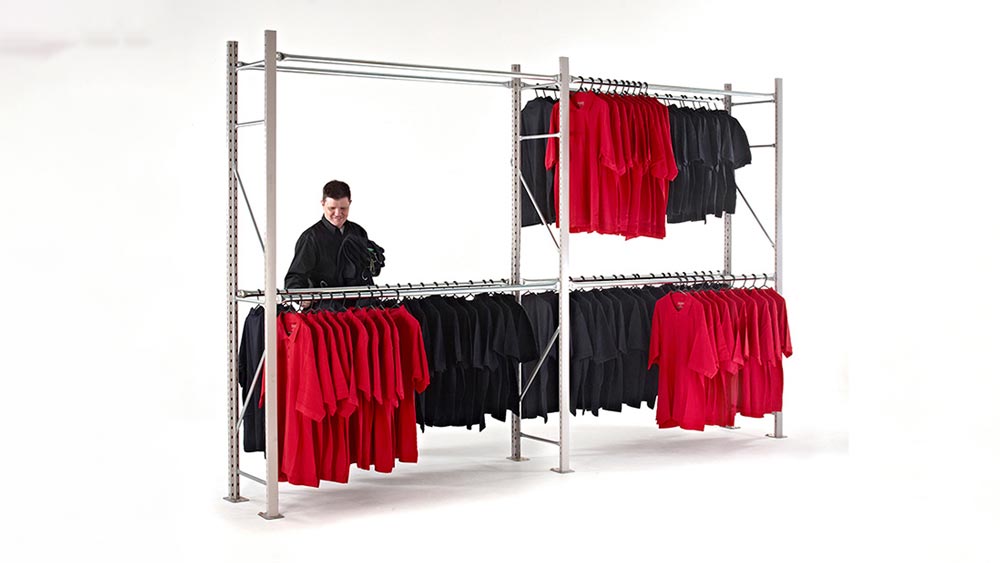
Core Storage Principles
The Core Conflict: Accessibility vs. Density
This is like the two ends of a scale. Accessibility refers to how easy it is to retrieve a particular piece of clothing. Density refers to how many pieces of clothing you can store in the same space.
- High Accessibility, Low Density: Imagine hanging all your clothes in a closet where you can easily reach any item. This is similar to a shelving rack. Every piece of clothing has its "exclusive spot," and pickers can find them quickly. This model is suitable for high-turnover items, such as new seasonal releases or best-sellers. Since they need to be moved in and out of the warehouse frequently, sacrificing a little space for efficiency is well worth it.
- High Density, Low Accessibility: Imagine folding all your off-season clothes and packing them into storage boxes, then stacking the boxes one on top of another. To get the one at the bottom, you have to move all the ones on top first. This is like a push-back racking system or a drive-in racking system. These racks use depth for storage, offering extremely high space utilization and the ability to store a massive amount of merchandise. However, their drawback is also obvious: you typically use a First-in, Last-out (FILO) method and cannot directly access the items in the back. This model is best for low-turnover items, such as off-season stock or reserve inventory, that don't move often, thus maximizing space utilization.
How to Balance Them?
You need to decide based on the turnover rate of your SKUs (Stock Keeping Units).
- Current best-sellers: Place them on shelving racks near the picking area for quick picking and restocking.
- Infrequently moved inventory and off-season items: Store them on high-density racks in the deeper parts of the warehouse to maximize space.
Product Protection: Racks are the "Armor" for Clothing
The value of clothing lies in its condition. Getting it dirty, wrinkled, or damp can lead to direct losses. A good racking system can act as "armor" to protect your garments.
- Dust Prevention:
- While open shelving is low-cost, clothes can easily accumulate dust, especially in high-traffic picking areas.
- Closed cabinets or adding dust curtains to the outside of the racks can effectively block out dust, which is particularly suitable for storing high-value or long-term stagnant apparel. Of course, this comes at a higher cost. You need to weigh the value of the clothing against the storage duration.
- Wrinkle Prevention:
- For garments that are prone to wrinkling, such as suits, dresses, and coats, hanging them is the best solution. Our professional hanging garment systems are specifically designed for this purpose.
- The core of a good hanging system is the hanging rail. It must not only bear weight but also protect the shoulder parts of the clothes from being compressed and deformed.
- Diameter: The diameter of the hanging rail should be moderate, typically between 25mm and 32mm. This provides enough support without being so thin that it crushes the hangers and leaves marks on the shoulders of the clothes.
- Material: It is best to use high-strength cold-rolled steel with an electrostatic spray coating on the surface. This makes it smooth and rust-resistant, preventing secondary pollution to the garments.
- Moisture Prevention:
- Moisture is a major enemy for clothing. The layout and height of the racks are crucial.
- Off-wall, Off-ground: The bottom of the racks should be at least 10-15cm above the ground, and the back of the racks should be 5-10cm away from the wall. This effectively prevents moisture from the ground and walls from seeping in.
- Promote Air Circulation: Sufficient aisles should be left between the racks to prevent them from being packed too tightly. This ensures air can flow freely throughout the warehouse, reducing the risk of localized moisture buildup.
Scalability and Flexibility: Adapting to Future Changes
The fashion industry changes quickly, and seasonal inventory fluctuates widely. Therefore, your racking system cannot be a "one-and-done" deal; it must be able to grow and change with your business.
- Adjustable Shelving: This is key to achieving flexibility. Whether it's shelving racks or cantilever racks, they should support the free adjustment of shelf heights.
- Imagine that bulky winter coats take up a lot of space—you can raise the shelves. Conversely, folded summer T-shirts don't take up much space, so you can lower the shelves to add more layers.
- This design allows you to easily handle the storage needs for different seasons and styles of clothing without buying new racks, which significantly saves future costs.
In-depth Analysis of Racking Solutions
Shelving Racking
Scope of Application: This type of rack is best for storing folded apparel, such as:
- T-shirts, hoodies, sweaters
- Jeans, sweatpants
- Socks, underwear, accessories
- Home textile products, like towels and bedsheets

In-depth Suggestion: While simply stacking clothes on shelves might seem easy, professionals wouldn't do it that way. We highly recommend using standard-sized fabric storage bins or plastic turnover boxes.
- Why use bins?
- Clear Classification: Each bin can hold a single SKU or a category of items, making them easy to find.
- Dust Protection: Even on open shelving, bins can provide extra dust protection.
- Neat and Tidy: The warehouse looks more professional, and management is more efficient.
Our shelving racking systems can be customized to your needs. For example, our common models have a load capacity of 200-300 kg per layer, with shelf depths of 40cm, 60cm, and so on. You can match the dimensions of the storage bins you use to ensure every inch of space is maximized.
Hanging Garment Racking
Scope of Application: This is the "star" solution for apparel warehouses, specially designed to protect the shape of garments.
- Suits, dresses, coats, wedding gowns
- High-end fashion, shirts, jackets
- Any garment you want to prevent from getting wrinkled
In-depth Suggestion: Hanging garment racks come in various forms, each with its unique advantages.
- Single-layer Hanging Racks:
- The most basic hanging solution, typically with a height of about 2 meters.
- Suitable for storing long items like coats or dresses.
- Pros: Simple and direct, high accessibility.
- Cons: Low space utilization, with a lot of wasted space above.
- Double-layer Hanging Racks:
- Effectively utilizes vertical space by dividing the rack into upper and lower layers.
- The lower layer can store shorter garments (like shirts and jackets), while the upper layer can store longer garments or be accessed with a vertical lift device.
- Pros: Space utilization is nearly doubled compared to single-layer racks.
- Mobile Hanging System (High-Density Solution):
- This is our most acclaimed solution. It mounts hanging garment racks on a movable base, with no traditional aisles between the racks. An aisle is opened when needed by turning a crank or using an electric control.
- Pros: In the same area, storage capacity can be increased by 200% or even more! The space traditionally used for aisles is fully utilized, greatly improving the warehouse's storage density. This offers an unparalleled advantage for warehouses in cities with high rent.
- Cons: Higher initial investment, and retrieval speed is slightly slower compared to fixed aisles.
Other Professional Solutions
- Drive-in/Push-back Racking:
- Application: Large-volume, single-style, low-turnover apparel, such as off-season inventory or uniforms produced in bulk.
- Principle: Forklifts can "drive into" the rack for storage and retrieval, and goods are handled in a First-in, Last-out (FILO) mode. This type of rack maximizes the depth of the warehouse space.
- Very Narrow Aisle (VNA) Racking:
- Application: Warehouses with high storage heights and extremely high space utilization requirements.
- Principle: The aisle width between the racks is compressed to the maximum, usually only 1.6-2.0 meters, and requires a special narrow-aisle forklift for operation.
- Pros: Extremely high space utilization, which fully takes advantage of the vertical height of the warehouse.
- Cons: Requires the purchase of specialized equipment and has high demands for floor flatness.
Beyond Hardware: Systemic Recommendations
Labeling and Identification System
A warehouse without labels is like a book without a table of contents; no matter how large the space, you can't find what you're looking for. A good labeling system allows your racks to perform at their maximum efficiency.
- Area Identification: First, create a macroscopic division of the entire warehouse. For example, divide the warehouse into areas A, B, C, etc., and place prominent large signs at the entrance of each rack aisle. This way, pickers can immediately know which area they are in upon entering the warehouse.
- Rack Localization: Next, pinpoint the exact location of each rack. For example, you can name them A-01-02-03, which represents "Area A - Row 01 - Level 02 - Position 03." On the front of each shelf level, install replaceable label holders with the corresponding location code. This ensures that even a new employee can quickly find the correct spot by following the code.
- SKU Identification: At each location, place a QR code or barcode containing information like the item's SKU, quantity, and size. Pickers can use a handheld terminal to scan it and confirm they have picked the correct item, greatly reducing picking errors.
Picking Path Optimization
Think about how many steps a picker takes in the warehouse every day. If the path is unreasonable, they are just wasting time and energy. A good rack layout can help you design the most efficient picking path.
- ABC Classification Method: This is a classic principle in warehouse management.
- A-class items (high turnover rate): Place them on the racks closest to the picking area and that are easiest to access.
- B-class items (medium turnover rate): Place them around the A-class item area.
- C-class items (low turnover rate): Place them on high-density racks in the deepest part of the warehouse. This way, pickers spend most of their time on high-value A- and B-class items, reducing unnecessary walking.
- "S" or "U" Shaped Path: The placement of racks should guide employees to walk in an "S" or "U" shape, avoiding backtracking. If the warehouse is large enough, you can design a circular path so that pickers only go in one direction, preventing crossing paths and congestion.
Technology Integration: WMS (Warehouse Management System)
Hardware is just the foundation; without software, your warehouse is like a computer without an operating system. A WMS (Warehouse Management System) is the brain of your warehouse.
- Real-time Inventory Management: The WMS can track the location, quantity, and status of every piece of clothing in real-time. When items are put in or taken out, the system automatically updates the inventory, allowing you to stay on top of stock levels at all times and avoid overselling or stockouts.
- Picking Task Assignment: Based on order information, the WMS can automatically generate the most optimal picking tasks and paths. Pickers use handheld terminals to follow the path and location prompts from the system, which greatly improves picking efficiency and accuracy.
- Visual Management: An excellent WMS can provide a 3D view of the warehouse, allowing you to intuitively see the inventory situation at each location. This not only helps you plan restocking more effectively but also saves a lot of time during inventory counts.
Common Misconceptions and Suggestions
Misconception 1: Choosing Racks with Inadequate Load-bearing Capacity to Save Money
This is the most fatal and dangerous misconception. Many customers, when making a purchase, only look at the price and blindly pursue the "cheapest" option. They think that since clothes are light, the cheapest racks will suffice.
- Consequences of the Error:
- Safety Hazard: If the racks' load-bearing capacity is insufficient and they become overloaded, the mild consequence is shelf deformation, while the severe one is the entire rack collapsing, causing personal injury and property damage. This is not just a financial loss; it is a matter of life and safety.
- Hidden Costs: Racks with a short lifespan need to be replaced or repaired soon, which actually increases long-term costs.
- My Suggestion:
- Safety first, no compromise. During the planning stage, be sure to provide the rack supplier with detailed information about your goods, including the weight of a single packaged item and the estimated load capacity per level. A professional supplier will perform load calculations and structural design based on your data.
- Don't just look at the upfront price; calculate the total cost. A high-quality, load-bearing rack might have a higher initial investment, but its long lifespan and reliability will save you a lot in repair and replacement costs.
Misconception 2: Blindly Pursuing High Density and Completely Sacrificing Picking Efficiency
We've talked about balancing density and accessibility before, but many people go to extremes in practice. They see that high-density racks can store more goods and wish they could turn their entire warehouse into a "push-back racking system."
- Consequences of the Error:
- Low Efficiency: If your best-selling items are all stored in high-density racks, pickers will spend a lot of time retrieving them, leading to extremely slow order processing and a poor customer experience.
- Picking Errors: Items are stacked together and are difficult to view directly, which increases the risk of picking errors.
- My Suggestion:
- Categorized storage is key. Remember the ABC classification method we discussed earlier. Place high-turnover A-class items on easy-to-access shelving or hanging garment racks, and place low-turnover C-class items in high-density racks.
- Use "high density" in the right places. High-density racks only make sense when you have a large inventory and a low SKU turnover rate. If your business is fast fashion and requires quick turnover, then racks with high accessibility should be your first choice.
Misconception 3: Ignoring Fire Regulations and Blocking Aisles with Rack Layouts
Some businesses, in an effort to maximize space, place racks so close together that they block fire aisles and emergency exits. This not only violates national regulations but also puts employees' lives at risk.
- Consequences of the Error:
- Serious Safety Hazard: In the event of an emergency like a fire, blocked aisles prevent people from evacuating quickly, and firefighting equipment cannot enter in time, with unimaginable consequences.
- Legal Liability: Violating fire regulations can lead to hefty fines or even more serious legal repercussions.
- My Suggestion:
- Fire regulations must be considered from the initial design stage. Ensure that the rack layout leaves sufficient fire aisles and complies with fire department regulations.
- Aisle width matters. Even regular aisles should have a width that meets the minimum turning radius of equipment like forklifts and picking carts to ensure smooth operations while also leaving a safe distance.
Conclusion
An excellent apparel warehouse is a combination of storage principles, suitable racking solutions, and efficient management. I hope this guide has been enlightening for you. If you have any questions, feel free to contact us.
As a rack manufacturer, our experts would be happy to provide a free analysis of your warehouse layout and offer personalized racking solution suggestions.